Eras Tour
Rohit Nalawade
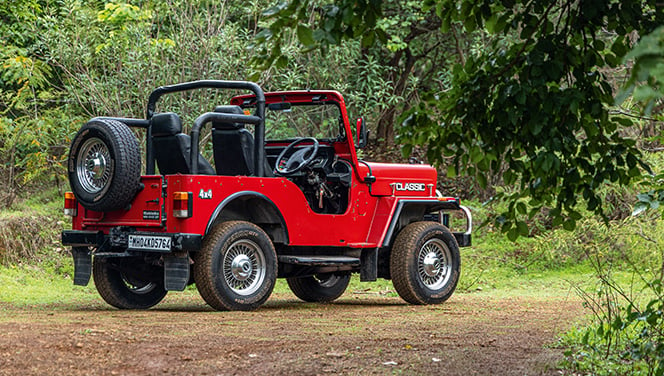
Clear,” I command with urgency over the walkie and the boot of the camera car driving ahead swings up, with Avdhoot, Raj and Rohan pointing their lenses at our trio of Mahindras with the precision of Army snipers. Vinod leads the pack in his firetruck red Mahindra Classic, wearing a windcheater that I’ve generously lent to him for when the skies open up over Igatpuri – there’s no roof for him to cower under. The Thar CRDe on the other hand is being piloted by the ever-faithful Pradeep from Mahindra Adventure. He’s driven the beast to Igatpuri from Mumbai, and his usually jovial face is currently replaced with one of concentration, as he’s following the instructions of our crew to place the car perfectly for a rolling shot. Bringing up the rear is me in the Burnt Sienna Thar Roxx. It’s the first time I’ve been behind the ’wheel of one, and I’m already falling in love. The view from the driver’s throne? Awesome. The seats? Cushy. The climate control has been set just so and the only struggle I’ve had so far is to resist the urge to hook up my phone via Apple CarPlay to the infotainment and crank up that Thar-spec playlist that is my guilty pleasure – this car actually belongs to Vinod and I don’t want him to be left with remnants of my questionable music taste.
“Car coming” hollers Rohan over the walkie from the camera car, interrupting my reverie and forcing the drivers of the three Mahindras to drop out from our formation and react in different ways. Vinod in the Classic slows down and heads for the shoulder on the left. The Classic might have newer and more expensive SUVs whipped when it comes to an off-roading contest, but on the road, the Peugeot diesel won’t pass muster when it comes to making a quick overtake to safety. Pradeep in the Thar has it relatively easier thanks to more power and enough poke from the engine to allow him to occupy the fast lane and let traffic pass by. In the Roxx, there has been no sense of panic whatsoever. A slight flex of my right foot and the slick-shifting automatic quickly makes a kickdown, and I’ve powered ahead of our convoy, including our camera car, without a second thought. I safely wait for them on the shoulder ahead, wait for our motley crew to bunch up, and we bank the shot that you see at the beginning of this story on the next clear stretch, much to the satisfaction of our camera crew. The routine exercise also sets the stage for how Mahindra’s 4x4s have changed and evolved with the pace of progress over the years. I, for one, am glad to be inside the cushy climes of the Roxx. Man, I am terribly spoilt...
The J-word Let’s address the elephant in the room first before we move to the three Mahindras pictured here. The reason why Mahindra’s core products looked like jeeps for the longest time is because the jeeps were what Mahindra started making. The entire saga has been described in its entirety in Adil Jal Darukhanawala’s excellent book, Timeless Mahindra, and the Mahindra story began with the company importing CJ-2A jeeps in India and later assembling them at its facility at the Mazgaon docks in Mumbai, then Bombay, in 1949. By 1954, Mahindra & Mahindra received the go-ahead from the Indian government to collaborate with the Willys-Overland export corporation to manufacture Jeeps under its phased manufacturing programme. And the rest, well, is history.


Topless Mahindra Which brings me to the Mahindra Classic, which was a consequence of Mahindra’s success in the export market. In the late 1960s, M&M started to receive large export orders for the CJ-3B and the CJ-4A. Yugoslavia was one of the first markets to take to the made-in-India 4x4s, as was Ceylon, specifically for use by the Ceylonese army. Jordan, Uganda, Philippines, Singapore, Indonesia, Nigeria were some of the markets where M&M managed to make inroads, and by 1990, Australia was added to the list, with the vehicles badged as the Mahindra Stockman, for rural markets and tradesmen, with a more upmarket leisure vehicle called the Bushranger. The Aussie motoring press dubbed these vehicles ‘The rugged beasts from Bombay’, and considering the export success, Mahindra debuted the Classic in 1996 India, with its luxuriously turned out form aiming to appeal to lifestyle buyers. The lure of the original Willys MBs, followed by the CJ-2A, CJ-3A and CJ-3B was still strong in the Indian psyche, and the marketing guys at Mahindra doubled-down on the fact, while perfecting the look of the vehicle. “Admit it. You’ve always been crazy about topless models,” was one of Mahindra’s most iconic ads for the Classic – the same ad that prompted one Vinod Nookala, then in high school, to eventually join Mahindra for an internship in 2004 and become the brand manager for the Thar CRDe that would be introduced in 2010. And needless to mention, he’s chuffed to have finally accomplished his lifelong desire to own a Classic.
The Classic was essentially the same vehicle as the CJ-340DP, Mahindra’s first attempt at making a vehicle to tap into the nostalgia appeal of its legacy products in India, but it was more refined and better built. It had been tastefully configured, complete with wire wheels shod with radial tyres, with disc brakes and a stainless steel ’roo-bar dominating the front. Under the bonnet lies the 2112cc XDP 4.90 B 4-cylinder diesel engine that was built by Mahindra under licence from Peugeot and it is mated to a 4-speed manual transmission from Kia, and once you fire it up, it is a stimulatory assault on the senses. The clatter and the noise is somewhat of a joy to experience in 2026 as we move into increasingly pro-EV times, and I can’t believe I got to take this very car for a short spin a few years ago, when we took the Thar 3-door with the convertible top to meet one of its predecessors. It’s not a piece of cake to drive, at least for a kid who grew up in the noughties with power steering being a mainstream thing by then, nor is the ride what you’d call, erm, comfortable, with rigid axles and leaf-springs all around. But that’s a matter of perspective. SUVs used to make a man out of you back then. Nowadays you’d get cancelled for simply thinking that thought out aloud. There’s no denying the appeal of this firetruck red example however. The wire wheels which are very hard to come by now are the reason why Vinod picked up this Classic in 2019, and ever since, he’s been hard at work to keep it aesthetically stock with stronger and more reliable mechanicals. “There are cars that get you from point A to point B. And there are cars that change your life. The Classic is what changed mine,” says Vinod proudly, one of the few times that the grizzled veteran from Mahindra Adventure gets gushy about an off-roader. A couple of years into the Classic’s life, mag alloy wheels were added to the equipment list, but after its short production life from 1996 to 2002, the Classic faded away from the Mahindra portfolio. The off-road capabilities are excellent, except for the fact Peugeot diesel isn’t the most powerful mill in the world and can need a fair bit of prodding to hustle the Classic up a steep slope, requiring you to take a greater run-up. All it needed was the go to match the show, which was addressed with the next chapter of Mahindra’s 4x4 evolution.
We dared to dream That’s the statement that Behram Dhabar made at the launch of the original Thar, following the discontinuation of the Mahindra’s MM line of vehicles that had been discontinued due to emission regulations. What followed was the Thar DI – with MM styling, conventional doors but the same chassis, wheelbase and MDI 3200 diesel engine as the Major, updated to meet BS4 emission norms. The Thar CRDe that’s pictured here is a different beast, the former being fathered by Behram Dhabhar and the DI being fathered by Shreekant Ambike. Despite the phasing out of the MM range, many factors were in favour of creating a vehicle that could see the joy that a vehicle similar to the MM could bring. Behram Dhabhar played a pivotal role in the CRDE’s development. He was deeply engaged with the off-road community, interacting with them, understanding their needs and incorporating those insights into the vehicle’s design. Shreekant Ambike co-led the project, and both were instrumental in bringing the Thar to life from a skunkworks project to the vehicle as we know it. The CRDe was a hybrid of sorts, with approaches and ideas going back to the original CJ-3B jeeps, incorporating the best innovations the company made through its own learnings. The engineers scavenged for parts in the Mahindra bin, which included an almost new chassis design and independent front suspension from the Bolero single cab pickup that was made for export markets. The rear end came from a 2010 Thar DI. The gearbox and the CRDe engine came from the New Engine Family seen in Scorpio. The 2498cc in-line 4-cylinder diesel engine was turbocharged with an intercooler, and produced 105hp and 247Nm, mated to a 5-speed manual gearbox. And even though this vehicle was raw, it was loved. Power and torque has always been the CRDe’s forte, and it can get to off-road locations in a jiffy, along with the mountain-flattening torque making driving off-road feel as easy as making a run to the grocery store. Along with the styling, some refinements to the interior and a five-speed manual transmission, further aided by the Divgi-Warner transfer case, the capability is astonishing. I know because I popped my off-roading cherry with one in the dunes of Jaisalmer, coincidentally, in the desert after which the Thar is named. Your arms continued to get a workout, so did your left leg after operating the clutch. The ride was relatively a step up over the Classic’s but it was still a fun weekend toy that couldn’t necessarily be an ideal daily driver. But it was loved. This generation of the Thar sold 61,000 odd units, positioned as Mahindra’s halo model, and it still commands a massive fan-following even today.
New breed The day goes on and Igatpuri’s normally predictable and heavy showers are nowhere in sight as I follow Vinod and Pradeep in the Thar Roxx through the trails of the Mahindra Adventure Offroad Training Academy. “Do I need 4-Low?” I ask Vinod, less out of doubt in the Mahindra’s ability but more out of concern since this Roxx is brand spanking new and I don’t want to go down in history as the journo who managed to get in a sticky situation with the car belonging to one of the head-honchos at Mahindra. Not a wise career strategy. Vinod quips back that the Roxx will do the trail in 2-High “Aaram se,” which translates to very easily in Hindi. Okay then.
This is the first occasion I’ve driven the Roxx off-road and I am treating it with kid gloves, apprehensive of its abilities. Very recently, I brought my sister to the Academy to sample the Thar 3-door as a part of the Trail Survivor course, and I didn’t sweat it since I knew the vehicle would do the heavy lifting for her. This time, I feel like I’m in her shoes when it comes to being nervous. Except, apart from keeping in account for the larger dimensions compared to the 3-door, the Roxx, in every sense, possesses the OG Thar’s DNA while being an evolution of the species. It still has a ladder-on-frame construction but what has evolved is the chassis and platform, dubbed M_GLYDE by Mahindra, which is made with high-strength steel and delivers excellent torsional rigidity while also being lightweight.
Many called this a stretched-out version of the Thar 3-door, but it is a world apart in terms of on-road plushness and sophistication. My initial impressions made the Roxx feel closer to the Scorpio-N in terms of outright comfort, but take it to the trails and this is essentially a larger and cushier Thar, which is no bad thing. I could go on about the tech gizmos that keep it moving in the right direction when off-roading, but to be honest, once you shift the gear selector into Drive and have engaged 4-Low on the transfer case, it doesn’t matter. This feels unstoppable. Except for when I manage to nearly get her stuck and am reminded of the usefulness of a diff lock.
Where the others require power and calculated inputs, the Roxx strokes your ego and is easy, forgiving, and more inviting. I almost don’t want to give back the keys to Vinod because I’ve had such a lovely time driving the Mahindra (which reminds me, I’ve forgotten to unpair my phone from the Roxx). The differences might be stark, but the DNA of a Mahindra 4x4 perseveres through. As the sun sets, all that remains is for me to choose which one I’d take for the long drive back home – and I know what I’d pick.


