Designing for the Unknown
Kashmir Off Road
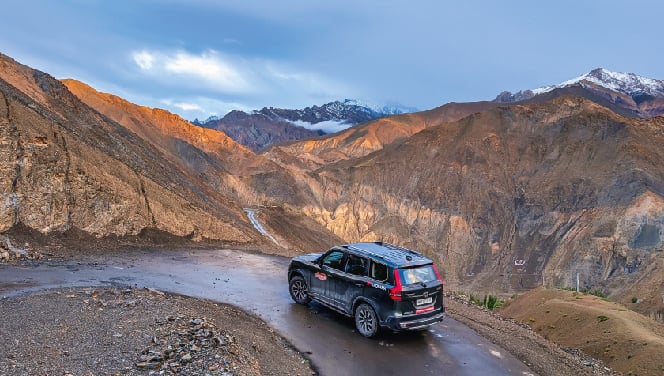
There are journeys that test a vehicle’s capability, and there are journeys that reveal what capability actually means.
We left Srinagar before dawn, heading towards Lamayuru to attend Yuru Kabgyat, one of Ladakh’s oldest monastic festivals. The route took us across Zoji La, through Drass and Kargil, into remote villages and mountain highways, covering nearly 700 kilometres before we returned home.
As with most Himalayan journeys, this one began with a reminder that real travel rarely follows a script. Just beyond Sonamarg, a herd of horses crossed the road, and one collided with our vehicle, damaging the left headlight. A temporary repair with tape held the assembly together for the rest of the trip. The incident lasted only a few moments, but it was a useful reminder that real-world conditions don’t care about test scenarios.
The Himalayas are unpredictable by nature. Weather shifts without warning, roads turn from smooth tarmac to broken surfaces within minutes, animals wander onto highways, landslides alter routes, and navigation systems sometimes struggle to keep up with reality. That unpredictability — not extremity — is what makes the Himalayas one of the most honest environments for understanding mobility.


For decades, vehicle development has focused on measurable capability: power, torque, ground clearance, approach angles. These metrics matter — they help vehicles reach difficult places. But after three days crossing mountains, villages and highways, we kept returning to a different question: what matters after the thirteenth hour? The answer, we found, was comfort.
We spent nearly thirteen hours reaching Lamayuru on the first day, crossing Zoji La, stopping at Minimarg, sharing tea in Matayen, meeting migratory shepherds near the Drass river, cooking lunch beside a stream near Pashkum, and exploring Henasku, also known as the Hidden Village. The weather moved constantly between sunshine, drizzle and cloud cover throughout. Yet by evening, our conversations weren’t about power or performance — they were about fatigue, or more precisely, the lack of it.
For mobility brands, that distinction matters. Capability gets people to a destination; comfort determines how they arrive. This becomes especially significant in family travel, where journeys stretching beyond ten or twelve hours mean seating support, ride quality, cabin space and visibility start to matter more than anything on a spec sheet. A capable vehicle can reach Lamayuru. A well-designed one lets its occupants stay engaged with the experience once they’re there.
The next day, we attended Yuru Kabgyat at Lamayuru Monastery. A cultural festival might seem unrelated to vehicle design at first glance, but mobility is woven into every part of such gatherings — roads keep communities connected, families travel long distances to participate, and traditions continue because access exists. Mobility isn’t just engineering; it’s participation. A vehicle’s value isn’t measured only by where it can go, but by the experiences it enables.
This became clearer once we left the main roads behind. After exploring Lamayuru and nearby Wanla village, we followed a narrow mountain road above the monastery — empty of tourists and traffic, with only dramatic skies, changing light and vast landscapes stretching across the horizon.
The following morning, we drove towards Kanji village. The road grew rougher and more isolated, until at one point our navigation showed little more than an arrow representing our position — the mapped road itself seemed to have vanished. Yet the village existed, with people living in ancient homes beneath mountains painted in shades of red, pink and brown.
For mobility designers, places like Kanji offer a useful lesson. Much of vehicle development happens within known parameters — engineers define conditions, test routes are selected, variables are controlled. The real world rarely behaves so neatly. Drivers often face situations where information is incomplete and conditions are unfamiliar, and in those moments, confidence matters as much as capability. Good mobility design doesn’t eliminate challenges — it helps people navigate them with confidence.
Another thing stood out through the journey: the features that dominated our experience weren’t necessarily the ones most heavily advertised. We listened to music occasionally, but beyond that, the digital features barely registered. What we noticed instead were the things working quietly in the background — visibility, driving position, storage, ride comfort, predictability, reliability. The best design often disappears into the experience. When a vehicle demands constant attention, occupants notice. When it quietly supports the journey, they focus on the landscape instead.
By the time we began our return to Srinagar, one more lesson had become clear. Most mobility conversations focus on extraordinary moments — mountain passes, off-road obstacles, extreme terrain. But much of our travel time was spent in far more familiar conditions: traffic approaching Kargil, congestion through Zoji La on the way back, long queues near Ganderbal caused by flooding and road disruptions. These moments rarely appear in marketing films, but they represent everyday reality for thousands of drivers. The true measure of mobility isn’t how a vehicle performs during five minutes of excitement — it’s how it performs during twelve hours of uncertainty.
Three days. Seven hundred kilometres. Changing weather, remote villages, cultural gatherings, mountain highways, traffic congestion. In the end, the features that dominate brochures rarely dominate conversations on the road. What people remember is how comfortable they felt after thirteen hours, how confidently they navigated unfamiliar terrain, how easily they carried everything they needed, and how little they worried about the vehicle itself.
Perhaps that’s the lesson the Himalayas offer mobility brands: capability may begin the conversation, but comfort, confidence and trust are what sustain it — long after the destination has been reached.


