Frozen valley, Warm Cabin ; Sleeping in the Himalayas with the Mahindra XEV 9S
Nikhil Chawla
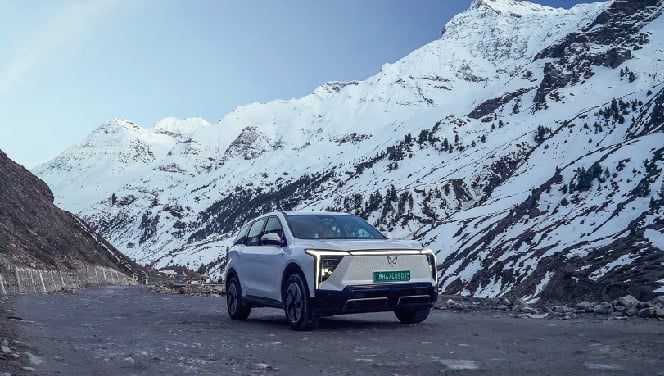
From the moment I drove the Mahindra XEV 9S out of that tunnel into the sharp April air — fresh snow blanketing everything in sight — I knew this car was going to be tested.
The Road to Sissu
The drive from Manali to Sissu through the Atal Tunnel covers about 60 kilometres, but it crosses two entirely different worlds. I had picked up the XEV 9S in Manali with a specific plan already in mind — one that would only make sense once I was deep enough into the valley, far enough from the nearest hotel, and cold enough to make the experiment real.
The XEV 9S is Mahindra’s newest and most ambitious electric SUV, launched in November 2025. Built on the INGLO electric skateboard platform — a purpose-built EV architecture, not a converted petrol vehicle — it seats seven and offers battery options up to 79kWh, with a claimed range of 679km. It is a family car by design, but on the road to Sissu in April, with fresh snow having fallen overnight, it felt like something closer to an expedition machine.


The route beyond the tunnel opens into a wide river valley that looked, that morning, as though someone had repainted the entire world white.
Fresh snowfall had settled on everything — the peaks, the road shoulders, the riverbanks, the rocks. The Chandra river ran alongside in a fierce, cold blue-green, indifferent to the new coat of white above it. The temperature drops steadily and visibly — you can watch it fall on the dashboard display with every kilometre. I had the Snow Drive Mode engaged throughout. The XEV 9S handled the off-road patches and rough mountain tarmac with quiet composure — 205mm of ground clearance, a flat-floor chassis sitting low and stable,
380Nm of torque available instantly and silently. There were no gear changes, no engine noise working against the gradient. Just clean electric thrust and the sound of wind against glass. I reached Sissu at around 5pm. Sissu in April
Sissu sits at just over 3,100 metres in a wide bowl of valley where the Chandra river bends sharply and the mountains close in from every direction. Most travellers know it as a summer stopover — a green, gentle place with a celebrated waterfall and apple orchards coming into bloom. In April, it is something else. The fresh snowfall had given the village a quality that felt almost unreal: every rooftop, every rock, every bare branch carrying a clean layer of white that hadn’t yet been disturbed by footprints or tyre tracks. The mountains above were enormous and silent. The waterfall, still running but framed by snow on every side, caught the late afternoon light and threw it back in silver.
The village itself was quiet — a few homestays, tea stalls getting ready to close, smoke rising from low rooftops. And a cold that despite the calendar saying April, arrived with the shadows and meant business.
When the sun dropped behind the western ridge, the temperature fell quickly. By the time I had explored the village and settled beside a bonfire, it was already -4°C and sinking.
The Plan: Camp Mode
This was the moment I had been building toward since Manali. The Mahindra XEV 9S has a feature called Camp Mode — a dedicated HVAC setting that keeps the cabin at a user-selected temperature while the car is parked and stationary, drawing efficiently on the battery without the engine running. Alongside it is Keep Mode, for maintaining cabin conditions, and PawPal Mode, designed to keep pets safe in a parked car. Camp Mode is, in essence, a hotel room you drove here yourself.
I wanted to test it properly, in conditions where it would actually matter. A sub-zero Himalayan night in the Lahaul valley, with the nearest heated room a short walk away, was exactly that.
The bonfire burned down to embers.
I stepped into the XEV 9S. Battery: 78 per cent. Range: 300+ kilometres. I folded the rear seats flat — made easy by the
INGLO platform’s flat floor, which eliminates the central transmission tunnel that makes sleeping in most SUVs awkward — and activated Camp Mode. Target temperature: 24°C. Outside: -4°C and falling.
Before sleeping, I did what felt entirely natural: I opened YouTube on the 12.3-inch passenger display — one of three screens spanning the dashboard, all powered by a Qualcomm Snapdragon processor — and watched content from the back of the car while the Harman Kardon 16-speaker system filled the cabin with sound that had no business being this good in a parked vehicle at 3,100 metres. The panoramic sunroof above revealed a sky absolutely thick with stars. Eventually, screens off.
Eyes closed.
The Night, by the Numbers I woke up at 2am. Cabin temperature: 24°C. Outside temperature: -7°C, sliding toward -8°C.
There was no cold in the car. No condensation. No clamminess. No sense of being sealed in a small space — the XEV 9S’s wide cabin and generous wheelbase of 2,762mm give it a room-like quality that holds even when you are lying flat in the dark. I lay still for a moment, aware of -8°C pressing against the glass from all sides, entirely unable to feel it.
I went back to sleep. At 5:45am, first light was beginning to define the eastern peaks in pale grey. Cabin temperature: still 24°C. Battery: 67 per cent. Remaining range: 250+ kilometres.
A full night of Camp Mode — holding 24°C against -8°C — had used just 11 per cent of the battery. Enough left to drive back to Manali, stop for a proper breakfast, and charge at leisure. I pressed start. The car moved immediately, silently, without a flicker of cold-weather hesitation. As if the night had been nothing.
What the Valley Taught Me
The Mahindra XEV 9S is built for families. For road trips, school runs, and the comfortable, connected driving that most people do most of the time. It is excellent at all of that.
But a night in Sissu in April — when the calendar says spring but the mountains haven’t got the memo — showed its other dimension — the one that only reveals itself when the road gets remote and the temperature gets real.
Camp Mode is not a feature for a brochure. At -8°C in the Lahaul valley, with fresh snow on the ground outside and the Milky Way overhead, it is the difference between the car being a vehicle and the car being a refuge. The Himalayas have been here for millions of years. They will outlast every technology we bring into them. But on this particular night, in this particular valley, the XEV 9S made them feel, for the first time, like somewhere you could truly stay.


